A Subscription Is Not an AI Strategy
A Subscription Is Not an AI Strategy
Walk into almost any SMB in Dubai or Abu Dhabi today and you will find ChatGPT or Claude already in the building. Sometimes it is a company plan; more often it is a handful of personal subscriptions that employees quietly pay for themselves. The owner has read that AI accelerates business, the subscription has been bought, and the box has been ticked. And yet, six months later, nothing fundamental about the business has changed. Invoices are still chased manually, the CRM is still out of date, and the month-end close takes exactly as long as it did before.
This is the story nobody shares on Instagram or LinkedIn. Influencer content shows the demo: a prompt goes in, something impressive comes out, the caption says "this replaced my team." What it never shows is the mid-sized trading company in Deira where the most advanced piece of AI infrastructure is one employee's personal ChatGPT account, used to rewrite emails. At Zorai.net we spend a lot of time inside these businesses, and the pattern is remarkably consistent: the tools are paid for, and the fundamentals that would let them actually move the business have never been touched.
The story that never makes it to the feed
Recent reporting on UAE SMBs puts numbers on what we see every week. Employees are racing ahead of their companies — drafting emails with ChatGPT, summarising meetings, speeding through routine work — but those gains stay personal, siloed, and unmeasured, because the tools sit entirely outside company systems. Meanwhile, surveys of small business owners show most are using general-purpose assistants like ChatGPT, Gemini, or Claude, a third are not spending anything at all, and a fifth say they simply do not see enough value yet.
On the other end of the spectrum, companies that rolled AI out enterprise-wide without governance are discovering the opposite problem: consumption compounds before the controls exist to manage it. Industry leaders in the UAE have been blunt about this — organisations are adopting AI "without clear visibility into where it is being used, what it is costing, or whether it is delivering meaningful business outcomes."
Both failure modes have the same root cause. Buying access to a model was mistaken for having a strategy, and nobody did the unglamorous work of asking: what problem in this business should this tool actually solve, and what does it need to be connected to in order to solve it?
Why the subscription alone doesn't move the business
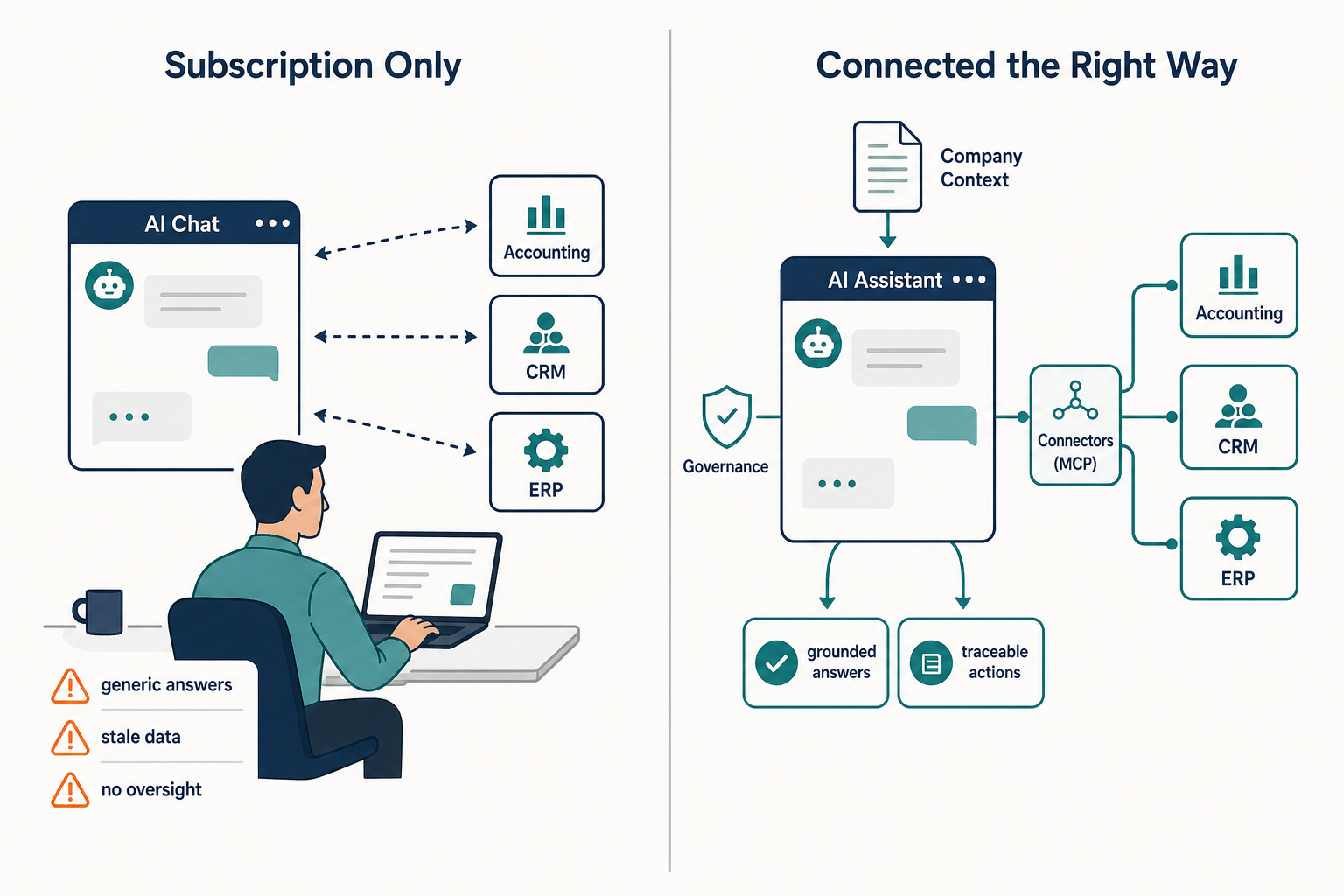
A blank chat box is a brilliant generalist that knows nothing about your business. It has never seen your Zoho Books ledger, your Salesforce pipeline, your Odoo inventory, or your FTA e-invoicing records. So when your accountant asks it "which customers are overdue and by how much," it can only answer in generalities — or worse, it answers confidently from data that was pasted in last Tuesday and is already stale.
The workaround everyone lands on is copy-paste: export a report, paste it into the chat, paste the answer back into an email. This has three problems. It is slow enough that people stop bothering. It sends customer and financial data into personal accounts with no oversight — a real concern when that data includes VAT-relevant transactions. And the output is only ever as good as the fragment that was pasted in, so the model never sees the full picture across finance, sales, and operations.
None of this is a flaw in ChatGPT or Claude. It is what happens when a powerful tool is used at arm's length from the systems that run the business.
Getting the fundamentals right: match the tool to the job
The first fundamental is choosing deliberately instead of by feed. ChatGPT Business and Claude Team both cost roughly the same per seat and both look similar in a demo, but they are not interchangeable, and the right choice depends on what your business actually does day to day — heavy document analysis, customer communication, data work, coding, or long-running research. The wrong way to choose is "the one the influencer used." The right way is to take your three most time-consuming workflows and test both tools against them for two weeks before committing the whole team.
The second fundamental is using the workspace features you are already paying for. Both platforms support projects or shared spaces where you load standing context once — your price lists, your service terms, your tone of voice, your VAT treatment for common scenarios — so every conversation starts already knowing your business instead of starting from zero. Most teams we meet have never opened this feature. They are paying for a tool that can remember and using it like one that cannot.
The third fundamental is governance from day one. Business plans exist for a reason: centralised billing, usage analytics, and spend controls, plus the assurance that your data is not being used for training. If employees are on personal accounts, the business has none of that — no visibility, no controls, and no way to capture what is being learned.
Integrations: where the real value actually lives
The step that separates businesses that get real value from those that do not is connecting the AI to the systems the business already runs. In 2026 this no longer requires a development project. Both major platforms now support the Model Context Protocol (MCP), an open standard for wiring AI assistants into business tools.
Claude ships with a connectors directory of over 950 services, and for Team and Enterprise plans an admin can authorise a connector once for the whole organisation, with access inherited through the company's existing identity provider. ChatGPT supports the same protocol through its apps and connectors system, with full read-and-write connectors available on Business and Enterprise plans.
What does this look like concretely for an SMB in the UAE? The systems these businesses run are well known: Zoho Books, QuickBooks Online, TallyPrime, or Xero for FTA-compliant accounting; Zoho CRM, Salesforce, or CorporateStack for customers; Odoo, Dynamics 365 Business Central, or NetSuite for inventory and operations. Once the assistant is connected to those systems — through directory connectors where they exist, or a small custom MCP connector where they do not — the conversation changes character entirely:
- "Which customers are more than 30 days overdue, and draft a follow-up for each in our usual tone" — answered from the live ledger, not a pasted export.
- "Summarise every open deal that has not moved in two weeks and tell me which ones mention pricing objections" — read directly from the CRM.
- "Cross-check this supplier invoice against the purchase order and flag any mismatch before it posts" — grounded in the ERP, not in whatever fit in the paste buffer.
The same subscription, the same monthly cost, a completely different level of usefulness. The difference is not the model. It is the plumbing — and the plumbing is now a configuration exercise measured in days, not a software project measured in months.
You don't need to rebuild everything
Here is where we differ from a lot of voices in this market, in both directions. The influencers say the subscription alone is enough. Some consultancies say the opposite: that you need a custom platform, a bespoke agent framework, a ground-up rebuild. We are strong advocates of a third position — you do not need to rebuild anything unless it is truly required.
In our experience, most SMBs get the large majority of the available value from three unglamorous moves: picking the right tool for their actual workflows, loading proper business context into the workspace, and connecting the assistant to the two or three systems where their data already lives. That is configuration, not construction. It preserves the tools your team already knows, it keeps your FTA and VAT records in the systems that were built to hold them, and it can be live in weeks.
Custom engineering earns its place only when the off-the-shelf path genuinely runs out — when data is fragmented across systems that cannot see each other and needs a unified layer underneath the AI, when a workflow needs an agent to act reliably and auditably rather than suggest, or when compliance requirements rule out the standard connectors. Those cases are real, and we build for them. But they are the minority, and starting there before the fundamentals are in place is how businesses end up paying for a platform when what they needed was a plumber.
How it fits together
The diagram accompanying this article shows the two paths side by side. On the left, the subscription-only pattern: an employee shuttling copy-pasted fragments between a chat window and the accounting, CRM, and ERP systems, getting generic answers while costs and data quietly leak. On the right, the connected pattern: the same assistant wired through connectors into the same systems, with company context loaded once and governance in place — producing answers grounded in live business data, and actions the business can trace.
Zorai.net's point of view
We do not start with tools; we start with your problem. The engagement usually begins with the least fashionable question in AI: what is actually costing you time and money right now? From there we map the shortest path — the right tool on the right plan, business context set up properly, and connectors into the systems you already run. Only when a problem genuinely cannot be solved that way do we reach for custom engineering, and when we do, you will know exactly why.
The subscription you already pay for is probably capable of far more than it is doing today. If you want to find out how much more — before spending a dirham on anything new — talk to us. Understanding your problem is the part we take most seriously, because it is the part the feed always skips.