Why a Unified Data Layer Is Essential for Agentic SaaS Solutions in UAE
Why a Unified Data Layer Is Essential for Agentic SaaS Solutions
At Zorai.net, we specialize in engineering-focused consulting that delivers hyper-targeted solutions for SMBs. Our expertise lies in creating tailor-made use cases for companies exploring AI, drawing on deep experience in the field.
The Current Landscape
Many SaaS providers now embed chatbot or agentic capabilities directly into their platforms, examples include Zoho and Salesforce. While these tools can automate interactions, they often lack a critical component: an aggregated data view that enables the system to communicate across the organization.
This gap is especially visible among SMBs in the UAE. In Dubai and Abu Dhabi, most small and mid-sized businesses run on a patchwork of systems adopted for specific, immediate needs: Zoho Books, QuickBooks Online, TallyPrime, or Xero for VAT and FTA-compliant accounting; Zoho CRM, Salesforce, or CorporateStack CRM for sales and customer management; Odoo, Microsoft Dynamics 365 Business Central, or Oracle NetSuite as ERP for trading, retail, and construction firms; and POS platforms for retail and F&B outlets. Each of these tools may have its own bolt-on chatbot or AI assistant, but none of them, on their own, sees the full picture across finance, sales, inventory, and operations.
What's Missing
Unified data layer – a single source of truth that consolidates information from all business systems.
Aggregated analytics – the ability to generate intelligent insights from that unified data.
Without these elements, the agentic features remain isolated, limiting their usefulness and preventing companies from extracting the full value of AI-driven automation.
Why a Unified Data Layer Matters
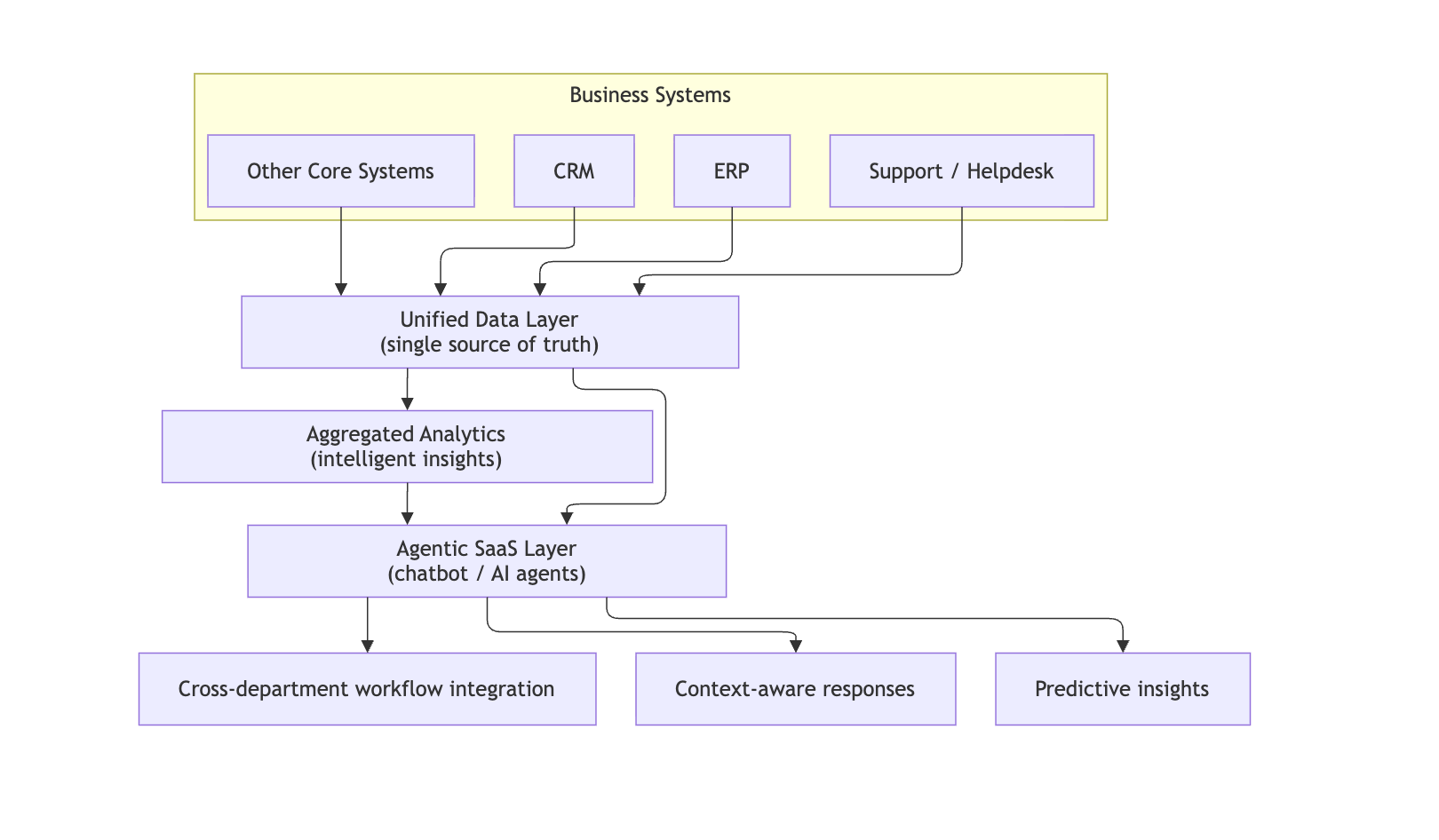
A unified data layer provides a consistent, real-time snapshot of the organization's data. When combined with an aggregated analytics view, it empowers agentic systems to deliver context-aware responses, offer predictive insights that drive decision-making, and seamlessly integrate with existing workflows across departments.
Our Approach
At Zorai.net, we help businesses build this foundational layer, ensuring their AI agents can access and interpret data from CRM, ERP, and other core systems, and produce actionable analytics that enhance productivity and customer experience.
For SMBs across Dubai and Abu Dhabi, this typically means connecting the systems already in daily use, Zoho Books, QuickBooks, or TallyPrime for accounting, Zoho CRM or Salesforce for customer data, and Odoo, Dynamics 365, or NetSuite for inventory and operations, into a single layer that any AI agent can query. This also keeps VAT and FTA e-invoicing records consistent across every connected system, rather than reconciled manually after the fact.
How It Fits Together
The diagram below shows how data flows from core business systems into a unified layer, through aggregated analytics, and into the agentic SaaS components that act on it.
(See accompanying diagram: business systems → unified data layer → aggregated analytics → agentic SaaS layer → context-aware responses, predictive insights, and workflow integration.)
Conclusion
For SaaS solutions to truly benefit from chatbot and agentic technologies, they must be built on a unified data foundation. By establishing this layer, companies can unlock smarter analytics, more effective automation, and a competitive edge in the AI-driven market.