Why n8n Is Not the Right Foundation for SMBs in the UAE
Why n8n Is Not the Right Foundation for SMBs in the UAE
If you spend any time on LinkedIn or Instagram, you have seen n8n. A colourful canvas of connected nodes, an AI agent that reads emails and posts to a CRM, a caption promising to "replace your whole ops team by Friday." It looks effortless, and that is exactly the problem. At Zorai.net, we build AI and agentic systems for SMBs across Dubai and Abu Dhabi, and we spend a fair amount of time helping owners understand why the tool that dominates their feed is rarely the tool that should run their business.
To be clear, n8n is a capable piece of software. It is open source, it self-hosts, and it has genuine strengths for certain jobs. But "capable in the right hands" and "the right foundation for an SMB's core operations" are two very different claims. This article is about the gap between them.
A flow-wise tool for a stateful business
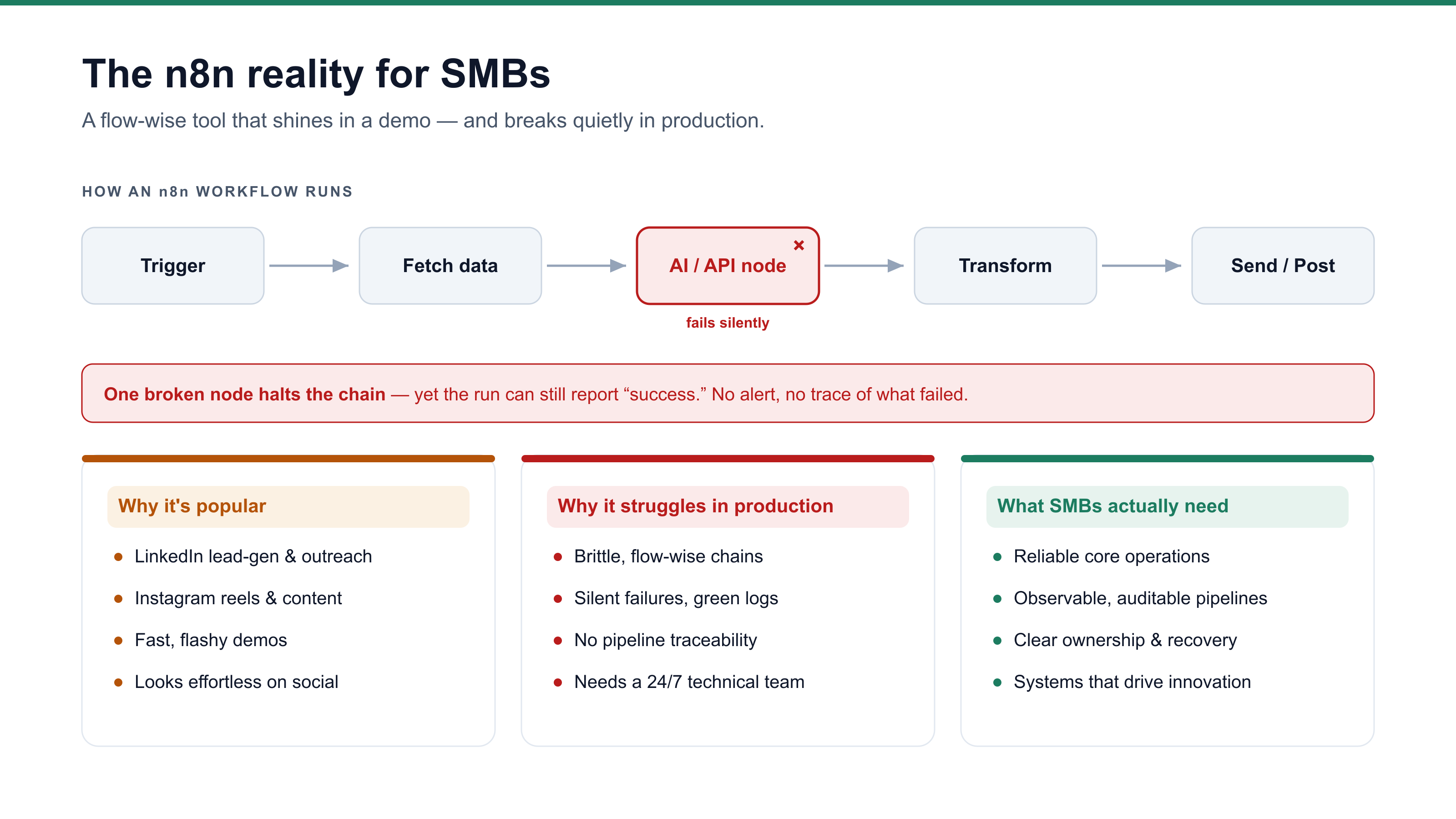
n8n is fundamentally flow-wise. You build a workflow as a chain of nodes: a trigger fires, data passes to the next node, then the next, until something happens at the end. That linear model is easy to demonstrate and easy to reason about for a single, happy-path scenario.
Real business operations are not linear or single-scenario. Invoicing, VAT reconciliation, inventory sync, and customer follow-up are stateful, interdependent processes with edge cases, retries, partial failures, and audit requirements. When you force that reality into a chain of nodes, you get a flow that works in the demo and fights you in production. The complexity does not disappear; it moves into the spaces between the nodes, where it is hardest to see.
The silent-failure problem
The most serious issue is not that n8n breaks. All software breaks. The issue is how it breaks.
n8n has a setting called "Continue on Fail." When it is enabled and a node errors out with a 500, an expired token, or an empty response, the workflow keeps running and the top-level execution is marked as a success. The error is quietly demoted into the data passed downstream, and your execution log shows green. A Google Sheets step returns zero rows because a filter silently stopped matching; every downstream node dutifully processes nothing; the final "send the report" step simply never runs. No error. No alert. The client just never gets their report, and nobody knows until they ask where it is.
This is not a fringe complaint. n8n's own community has documented at length that execution status, node status, and even the native OpenTelemetry spans can all report "OK" while the run was, in fact, broken. The status lies at every layer. For a marketing automation that missed one LinkedIn post, that is a shrug. For an SMB where that pipeline was posting VAT-relevant transactions or reconciling FTA e-invoicing records, a run that is "green but broke" is a compliance and cash-flow problem you discover weeks later.
Traceability is not free — and it is not built in
When we say n8n offers no traceability on the pipelines, we mean out of the box. You can bolt on visibility, but look at what "doing it properly" actually requires, according to n8n's own production guidance:
- An Error Trigger workflow wired to a named alert channel with a named owner.
- OpenTelemetry tracing configured with the correct environment variables on the main instance and every worker, plus a backend like Jaeger or Grafana to receive the traces.
- Explicit IF nodes after every critical step to check for
$json.erroror a zero item count, because the engine will not surface those failures for you. - An external watcher running on a schedule to catch the runs that finished green but produced nothing — and to catch the case n8n can never see, where the workflow did not fire at all.
- Retry logic, idempotency keys, and a dead-letter queue for failed runs.
That is not an automation. That is a distributed system with an observability stack, and someone has to build it, own it, and keep it running. Which brings us to the real cost.
It quietly assumes you have an engineering team
Every honest comparison of n8n says the same thing: it is more powerful than Zapier, and it is not easier. You need people who are comfortable reading JSON, understanding APIs, and debugging when something breaks — and, given the failure modes above, someone effectively on call to notice when it does. Even the vendor-friendly guides recommend hiring an agency for the initial 10-to-20 hours of setup.
Most SMBs in the UAE do not have that team. A trading company in Deira, a clinic in Abu Dhabi, or an F&B group running a handful of outlets has a small finance team, an office manager, and maybe one IT contact. They run Zoho Books, QuickBooks Online, or TallyPrime for FTA-compliant accounting; Zoho CRM or Salesforce for customers; Odoo, Dynamics 365 Business Central, or NetSuite for inventory and operations. What they do not have is a spare engineer to babysit a node graph at 2am when a token expires mid-run. Adopting n8n for core operations means either building that capability or outsourcing it indefinitely — an ongoing dependency, not a one-time automation.
Popular for the feed, not for the finance system
There is a reason n8n went viral. The wave of automation "gurus" through 2024 and 2025 built an enormous library of templates, and the tool is genuinely excellent for the things that look good in a 30-second reel: scrape some leads, enrich them, draft outreach, schedule content, auto-reply to DMs. These are low-stakes, marketing-adjacent tasks where a silent failure costs you one missed post, not a misfiled tax record.
That is the honest niche: LinkedIn lead-gen, Instagram content, and impressive one-off showcases. It is a poor match for the systems an SMB actually depends on — the ones that touch money, compliance, and customers of record. Popularity on social media is not evidence of production fitness. It is evidence that the tool demos well.
The innovation SMBs need is not more brittle plumbing
Here is the part that matters most. The businesses we work with are not asking for another fragile pipeline. They want AI that understands their operation: an agent that can answer "which customers are overdue and why," that reconciles across accounting and CRM, that flags a VAT discrepancy before the filing deadline, that surfaces the insight nobody had time to look for. That kind of innovation requires a reliable, observable, well-understood data foundation underneath it. A chain of nodes that fails silently and cannot tell you what it did is the opposite of that foundation. You cannot build trustworthy intelligence on top of infrastructure you cannot trust.
Zorai.net's point of view
We are not against automation, and we are not dogmatically against n8n — it has a place for the marketing-style tasks it does well. What we are against is putting an SMB's core operations on a flow-wise system that hides its own failures and demands an engineering team the business does not have.
Our approach is the inverse. We build on a unified, observable data layer where every pipeline is traceable by design: you can see what ran, what it changed, and what failed, without wiring together an observability stack yourself. Agents sit on top of that foundation with clear ownership and recovery paths, so a failure is loud and handled rather than silent and discovered late. For an SMB in Dubai or Abu Dhabi, that is the difference between an automation you have to watch and a system you can rely on — and the only kind of foundation that can actually carry the innovation these businesses are being promised.
If your team is weighing n8n for anything beyond social-media automation, talk to us first. The demo is the easy part. Running it in production, correctly, for years, is the part that decides whether the investment pays off.